



In Arizona, the parent who can make school decisions depends on the legal decision-making order. Education is specifically included within legal decision-making under A.R.S. § 25-401. If parents share joint legal decision-making, neither parent automatically has greater authority unless the parenting plan or court order gives one parent final authority over education.
School choice can become especially complicated because Arizona families may be choosing among neighborhood schools, open-enrollment schools, charter schools, and specialized programs. Arizona family courts now use Education Order forms that address school selection, enrollment and withdrawal, and services such as IEPs and 504 Plans. For separated parents in Mesa, Chandler, Gilbert, and the East Valley, a school decision can also affect transportation, parenting time, childcare, and stability.
At Nye Family Law, our experienced family law attorneys can help you understand your rights and responsibilities. The first step is to call to set up an initial consultation.
Why School Choice Disputes Matter in Arizona
Arizona parents have more education options than many families realize. That flexibility can create conflict when parents living in separate households prefer different schools.
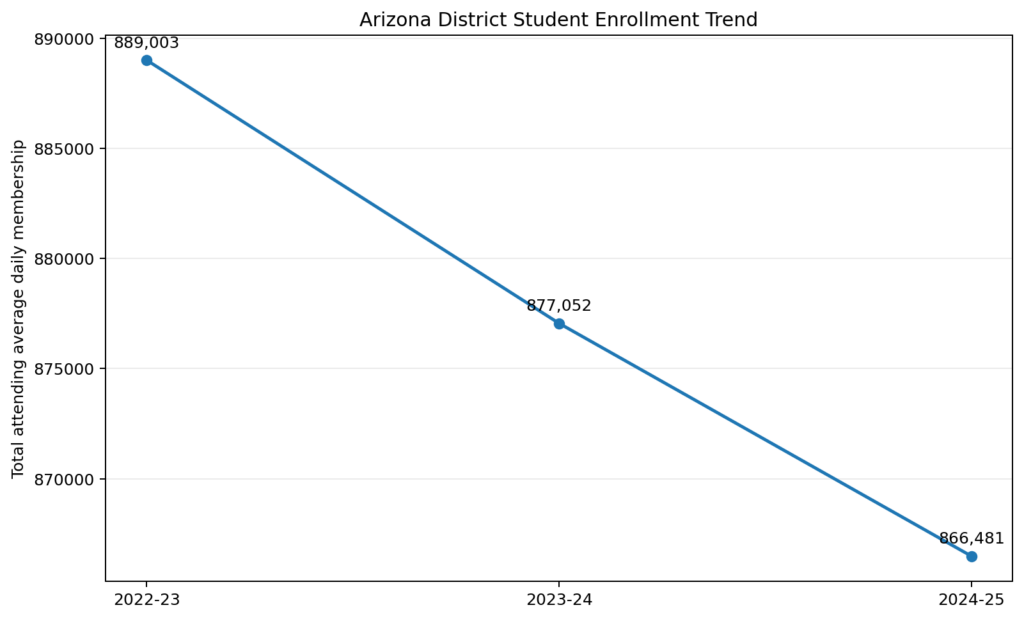
The Arizona Department of Education reported fall 2024 enrollment of 871,526 students across 1,577 district schools. State financial reports also show that the total district-attending average daily membership fell from approximately 889,003 in 2022-23 to 866,481 in 2024-25.
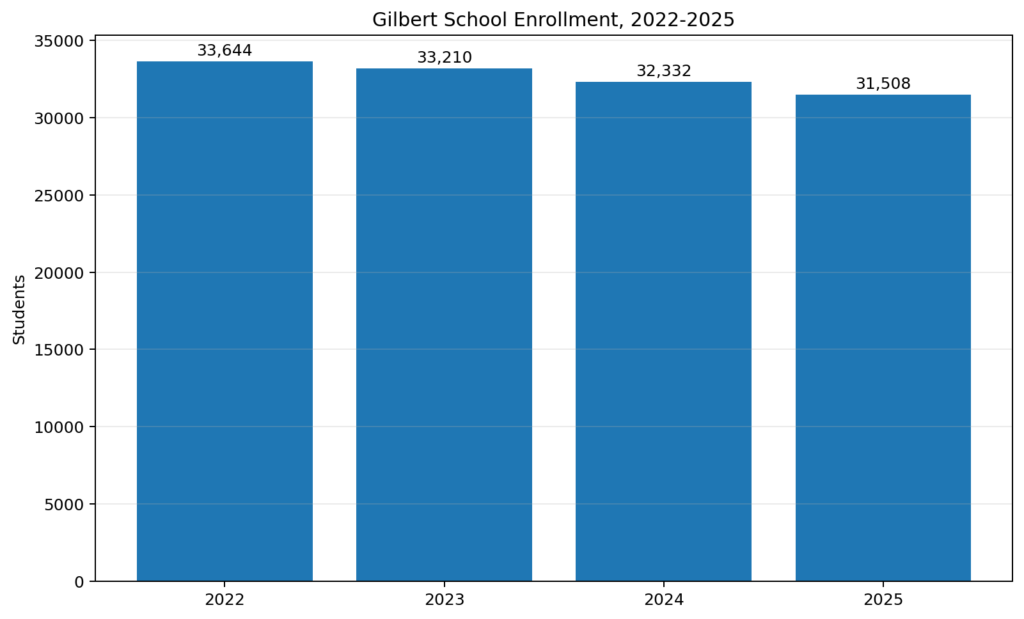
Local districts are changing too. Mesa Public Schools projected a decline of about 1,800 students for the 2025-26 school year and cited a 28% decline in the City of Mesa’s birth rate over the prior decade. Gilbert’s public data show that school enrollment declined from 33,644 in 2022 to 31,508 in 2025.
These numbers matter because open enrollment, school capacity, special programs, and transportation can all become practical issues in a parenting dispute.
Who Has the Legal Right to Choose a Child’s School?
Arizona law uses the term legal decision-making instead of legal custody. A.R.S. § 25–401 defines legal decision-making as the right and responsibility to make nonemergency decisions for a child, including education, health care, religious training, and personal care.
Joint Legal Decision-Making
With joint legal decision-making, both parents share authority. Neither parent’s rights are automatically superior unless the final order gives one parent greater authority over a specific category.
A parent should not assume that having more parenting time automatically entitles them to change schools.
Sole or Final Educational Authority
A court may give one parent sole legal decision-making or final authority over education. If the existing order contains that language, it can determine how a disagreement is handled.
The wording of the parenting plan matters more than informal labels such as “50/50 custody.”
Arizona’s Education Order Makes School Issues More Specific
The Arizona Supreme Court permanently adopted the Education Order forms pursuant to Rule 97 of the Arizona Rules of Family Law Procedure, effective January 1, 2025.
The Joint Legal Decision-Making Education Order addresses:
- School selection
- Enrollment and withdrawal
- IEP and 504 Plan services
- Access to school information
- How parents handle disagreements
- Whether one parent has presumptive or final authority
The form also states that the parenting plan controls if it conflicts with the Education Order.
For parents, that means school decisions should be addressed by reading the actual final orders before anyone tries to transfer or withdraw a child.
What Happens if Parents Cannot Agree on a School?
If parents share decision-making and neither has final authority over education, one parent generally cannot solve the dispute simply by enrolling the child first.
Arizona’s Education Order provides that when neither parent has greater authority, no change should be made unless the parents agree or a court orders otherwise.
The order also recognizes open enrollment. A parent may submit documentation to reserve a place at a preferred school, but reserving a seat does not automatically establish the right to make the final enrollment decision.
Open Enrollment Can Complicate Custody Cases
Arizona’s open-enrollment system means school choice is not always based solely on a home address.
Chandler Unified says open-enrollment applications may require recent grades, attendance records, discipline reports, and a current IEP when applicable. Gilbert Public Schools also accepts open-enrollment applications and publishes capacity by school, grade, and specialized program.
East Valley Open Enrollment Capacity Snapshot
Current published capacity examples:
- Chandler High School: 3,306
- Casteel High School: 2,952
- Gilbert High School: 2,600
- Highland High School: 3,300
These are capacity figures, not current enrollment totals, and availability can change. Parents should verify current information before building a legal argument around a specific school.
What Does an Arizona Judge Consider in a School Dispute?
A school fight is a legal decision-making issue, so the child’s best interests remain central.
A.R.S. § 25-403 requires courts to consider factors affecting the child’s physical and emotional well-being. One specifically listed factor is the child’s adjustment to home, school, and community.
Useful evidence may include:
- Academic performance and attendance
- IEP or 504 Plan information
- Distance from each parent’s home
- Transportation and exchange logistics
- Childcare arrangements
- Established friendships and activities
- Each parent’s work schedule
- Enrollment deadlines and actual availability
The question is not simply which school has the better rating. The court is looking at how the decision affects the child’s real life.
Local Issues for Mesa, Chandler, and Gilbert Parents
East Valley parents often have several school choices within a relatively small geographic area, but a parenting schedule still has to work day-to-day.
Mesa Public Schools offers neighborhood schools, accelerated academies, STEM and arts programs, career academies, and other options for 2026-27. Gilbert Public Schools began the 2026-27 year serving more than 30,000 students across 38 campuses.
A school that works well for one household can create a long commute for another. A specialized program may affect transportation, aftercare, extracurricular activities, or exchange times.
Parents should evaluate the entire weekly routine before taking a firm position.
When Should You Talk to a Family Law Attorney?
School disputes can become urgent because enrollment deadlines do not wait for family court litigation.
Legal guidance is especially important when:
- One parent is threatening to withdraw the child without agreement
- Joint decision-makers cannot agree
- The parenting plan is unclear about education
- A child needs an IEP, 504 Plan, or specialized service
- A move affects both school and parenting time
- An open-enrollment deadline is approaching
At Nye Family Law, we help Arizona parents understand what their existing orders allow and what options are available when an education dispute cannot be resolved informally.
Frequently Asked Questions
Can one parent change a child’s school without the other parent’s permission in Arizona?
It depends on the legal decision-making order. With joint legal decision-making and no final educational authority assigned, one parent generally should not make a unilateral change to the child’s school.
Does the parent with more parenting time automatically choose the school?
No. Parenting time and legal decision-making are separate concepts under Arizona law.
Can a parent apply for open enrollment before the other parent agrees?
Arizona’s Education Order allows a parent to submit paperwork to reserve a place for open-enrollment purposes. That does not necessarily resolve the legal authority to make the final school decision.
What happens if a child has an IEP or 504 Plan?
Special services are specifically addressed in Arizona’s Education Order. Parents should follow the legal decision-making provisions in their orders and work with the school while the dispute is resolved.
Will a judge simply choose the highest-rated school?
Not necessarily. The best-interest analysis can include school stability, transportation, special needs, parenting schedules, and the child’s adjustment to home, school, and community.
Talk to Nye Family Law About an Arizona School-Choice Dispute
A disagreement about school can quickly become a disagreement about legal decision-making, parenting time, transportation, and stability.
Nye Family Law represents parents in Mesa, Chandler, Gilbert, Phoenix, and surrounding Arizona communities in child custody, parenting plan, and related family law matters. Attorney Dexton H. Nye is a former prosecutor and is bilingual in English and Spanish. We focus on clear guidance, individualized strategy, and practical solutions.
Call 480-253-9065 to schedule a consultation.