



We represent San Tan Valley parents in legal decision-making authority and parenting time matters filed in Pinal County Superior Court. Attorney Dexton H. Nye is a former prosecutor who is bilingual in English and Spanish and guides parents through joint and sole legal decision-making arrangements, parenting plans, relocation disputes, and custody modifications under Arizona Revised Statutes Title 25. Arizona courts decide these matters based on the best interests of the child under A.R.S. 25-403, weighing factors such as each parent’s relationship with the child, stability, and any history of domestic violence or substance abuse.
Why San Tan Valley Parents Choose Our Firm
Custody disputes are among the most emotionally difficult matters a parent can face, and we understand that what happens in a Pinal County courtroom can shape a family’s daily life for years to come. Attorney Dexton H. Nye brings a former prosecutor’s courtroom experience to every custody matter, along with the ability to communicate directly with Spanish-speaking clients without relying on a third-party interpreter during sensitive conversations.
We limit our caseload so that each client receives direct access to their attorney rather than being routed through a rotating team of paralegals. Whether we are helping a parent negotiate a cooperative parenting plan or preparing for a contested custody trial, we build our strategy around the specific facts of each family rather than applying a one-size-fits-all approach.
Many of our San Tan Valley clients are surprised to learn that their case is filed in Pinal County Superior Court rather than Maricopa County, even though the surrounding East Valley communities of Mesa, Chandler, and Gilbert fall under Maricopa County jurisdiction. We know the local rules, scheduling practices, and expectations of the Pinal County court system, which helps us guide clients through the process with fewer surprises.
Understanding Legal Decision-Making Authority and Parenting Time in Arizona
Arizona law does not use the term custody in its statutes. Instead, the law refers to legal decision-making authority, which is the right to make important decisions about a child’s education, health care, and religious upbringing, and parenting time, which is the schedule that determines when a child is physically with each parent. These two concepts are often addressed together, but they are legally distinct and can be structured differently depending on the family’s situation.
Under A.R.S. 25-403, Arizona courts decide legal decision-making authority and parenting time based on the best interests of the child. The court does not favor one parent over the other based on gender, and both parents start on equal footing unless evidence shows that an arrangement would not serve the child’s best interests.
Types of Legal Decision-Making Arrangements
Joint Legal Decision-Making
Joint legal decision-making means both parents share the authority to make major decisions about the child. This does not necessarily mean equal parenting time, since the two concepts are separate. Many Arizona families use joint legal decision-making paired with a parenting time schedule that is not evenly split, particularly when one parent has historically handled more day to day caregiving.
Sole Legal Decision-Making
Sole legal decision-making gives one parent the exclusive authority to make major decisions. Arizona courts generally prefer joint arrangements when both parents are fit and willing to communicate, but sole legal decision-making may be appropriate when there is a documented history of domestic violence, substance abuse, or an inability to cooperate on basic parenting decisions.
How Arizona Courts Determine Best Interests
A.R.S. 25-403 directs courts to consider a range of factors when determining what arrangement serves a child’s best interests.
These factors include the past, present, and potential future relationship between the parent and the child, the interaction and interrelationship of the child with parents and siblings, the child’s adjustment to home, school, and community, the mental and physical health of everyone involved, and which parent is more likely to allow the child frequent and meaningful contact with the other parent. Courts also weigh any coercion or duress used to reach a custody agreement and any history of domestic violence or child abuse.
We help clients present evidence on these factors in a way that is organized, credible, and focused on what actually matters to a Pinal County Superior Court judge. This often includes school records, medical documentation, communication logs, and witness testimony where appropriate.
Comparing Legal Decision-Making Arrangements
| Factor | Joint Legal Decision-Making | Sole Legal Decision-Making |
|---|---|---|
| Who Decides Major Issues | Both parents together | One designated parent |
| Best Suited For | Parents who can communicate and cooperate | Cases involving abuse, addiction, or an inability to cooperate |
| Court Preference | Generally preferred when appropriate | Ordered when joint arrangements would not serve the child |
| Parenting Time | Determined separately, not automatically equal | Determined separately, not automatically limited |
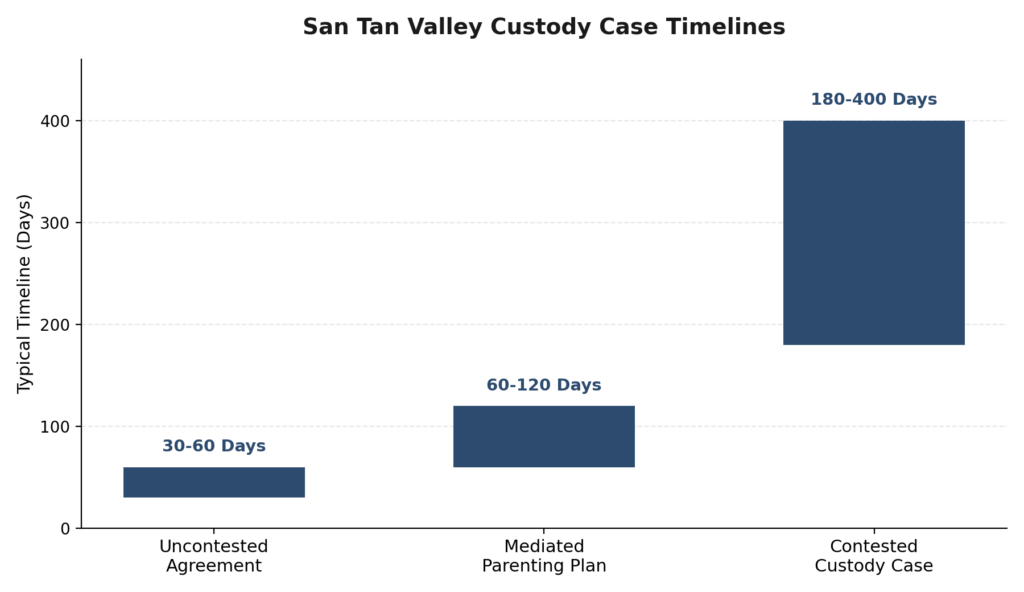
Chart: Typical Timeline for a San Tan Valley Custody Case
The Parenting Plan Process
Arizona courts require parents seeking joint legal decision-making to submit a written parenting plan under A.R.S. 25-403.02. A parenting plan outlines how the parents will make decisions, how the parenting time schedule will work, how holidays and school breaks will be divided, and how future disputes will be resolved. Parents who reach an agreement can submit their plan for court approval without a contested hearing. Parents who cannot agree may need the court to decide these issues after a trial.
We regularly draft parenting plans that anticipate common points of future conflict, such as extracurricular activities, travel outside Arizona, and communication between the parties, so that families spend less time back in court resolving avoidable disputes.
Domestic Violence and Custody Decisions
Arizona law requires courts to weigh evidence of domestic violence when making legal decision-making and parenting time determinations under A.R.S. 25-403.03. If a parent has committed an act of domestic violence, the court presumes that joint legal decision-making is not in the child’s best interests, though this presumption can be addressed with appropriate evidence. Supervised parenting time, safe exchange locations, and other protective measures may be ordered to protect a child and the other parent while still preserving a relationship where appropriate.
If safety is a concern in your case, tell your attorney immediately so we can build appropriate protective measures into your custody strategy from the outset.
Relocation and Custody
Arizona law places specific requirements on a parent who wants to relocate with a child, whether within the state or out of state. Under A.R.S. 25-408, a parent generally must provide written notice at least forty-five days before a planned relocation if the move would affect the other parent’s parenting time.
The other parent can object, and if the parties cannot agree, the court will decide whether the relocation is in the child’s best interests. Relocation disputes are among the most contested custody issues we handle, since a move can significantly affect an existing parenting time schedule.
Modifying a Custody Order
A legal decision-making or parenting time order is not necessarily permanent. Arizona law allows a parent to request a modification when there has been a substantial and continuing change in circumstances since the last order. Common examples include a parent relocating, a change in a child’s needs, a parent’s diminished ability to care for the child, or a documented pattern of one parent interfering with the other’s parenting time.
Courts generally will not revisit legal decision-making arrangements more than once per year absent evidence of an emergency, so timing and documentation matter considerably in a modification request.
Grandparent and Third Party Rights
In limited circumstances, Arizona law allows grandparents and other third parties to petition for parenting time or legal decision-making authority under A.R.S. 25-409. These petitions require specific conditions to be met, such as the child’s parents being unmarried, divorced, or one parent being deceased or missing for an extended period. We can evaluate whether a grandparent or third-party petition is appropriate given your family’s specific circumstances.
Frequently Asked Questions
Does Arizona favor mothers or fathers in custody cases?
No. Arizona law does not favor either parent based on gender. Legal decision-making and parenting time decisions are based on the best interests of the child under A.R.S. 25-403.
What is the difference between legal decision-making and parenting time?
Legal decision-making authority is the right to make major decisions about a child’s education, health care, and religious upbringing. Parenting time is the schedule for when the child is physically with each parent. The two are addressed separately under Arizona law.
Can I move to a different state with my child after a custody order?
Generally, you must provide written notice to the other parent at least forty-five days before a planned relocation if it would affect their parenting time under A.R.S. 25-408. The other parent can object, and a Pinal County Superior Court judge may need to decide the issue.
How do Arizona courts handle custody cases involving domestic violence?
Courts must consider evidence of domestic violence under A.R.S. 25-403.03, and a documented history creates a presumption against joint legal decision-making, though the court retains discretion based on the specific facts presented.
Can grandparents get custody or visitation in Arizona?
In limited circumstances, grandparents can petition for parenting time or legal decision-making authority under A.R.S. 25-409, provided certain statutory conditions regarding the parents’ marital status are met.
How long does a contested custody case take in San Tan Valley?
A contested custody case filed in Pinal County Superior Court can take six months to over a year depending on the complexity of the issues and the court calendar, while an uncontested agreement can often be finalized in a matter of weeks.
Speak With a San Tan Valley Child Custody Lawyer
If you are facing a custody dispute or need to modify an existing order, our team at Nye Family Law is ready to help you understand your options under Arizona law. Call our office at 480-253-9065 to schedule a consultation with Attorney Dexton H. Nye.