



Dividing property during a divorce can quickly become one of the most challenging parts of the process. Arizona follows community property laws, which generally require marital assets and debts to be divided fairly between spouses. However, determining what qualifies as community property, valuing complex assets, and protecting separate property often involve much more than simply splitting everything in half.
At Nye Family Law, we help clients throughout San Tan Valley navigate every aspect of asset division. Whether your divorce involves a family home, retirement accounts, business interests, investments, or significant debts, we work to protect your financial future through strategic planning and experienced legal advocacy.
Our firm helps clients with:
- Community property division
- Separate property disputes
- Retirement account division
- Business valuations
- Real estate division
- High-asset divorce
- Hidden asset investigations
- Debt allocation
- Property settlement negotiations
- Court litigation when necessary
If your financial future is on the line, we are ready to help you move forward with confidence.
Protecting What You’ve Worked Hard to Build
Dividing property during divorce is about much more than who gets the house.
Your retirement savings, investments, business interests, vehicles, debts, and even future financial security may all be affected by the decisions made during your divorce.
At Nye Family Law, we know every asset tells part of your family’s financial story. Our job is to help ensure that story ends with a fair outcome.
We represent individuals throughout San Tan Valley and Pinal County in both negotiated settlements and contested asset division cases. From straightforward community property matters to high-net-worth divorces involving complex financial portfolios, we develop customized legal strategies designed to protect your interests.
Every case deserves careful preparation because even small mistakes during property division can have lasting financial consequences.
Why Clients Choose Nye Family Law
Asset division is rarely as simple as splitting everything down the middle.
Our clients choose us because we take the time to understand every financial detail before recommending a legal strategy.
When you work with our firm, you receive:
- Personalized legal strategies
- Clear communication throughout your case
- Thorough financial analysis
- Strong courtroom advocacy
- Practical negotiation skills
- Compassionate representation during difficult transitions
Attorney Dexton H. Nye approaches every divorce with the understanding that today’s financial decisions can impact your future for decades.
Understanding Arizona Community Property Laws
Arizona is one of only a handful of community property states.
That means property acquired during the marriage generally belongs to both spouses regardless of whose paycheck purchased it or whose name appears on the title.
However, community property law is much more nuanced than many people realize.
Questions often arise involving:
- Separate property
- Inheritances
- Gifts
- Businesses
- Retirement accounts
- Appreciation of assets
- Real estate
- Debts
- Commingled funds
Understanding these distinctions is critical before agreeing to any property settlement.
Community Property vs. Separate Property
One of the first questions we answer is whether an asset belongs to the marital community or to one spouse individually.
Arizona Property Classification
Property Type | Generally Community Property | Generally Separate Property |
Income earned during marriage | ✔ | |
Home purchased during marriage | ✔ | |
Retirement earned during marriage | ✔ | |
Vehicles purchased during marriage | ✔ | |
Property owned before marriage | ✔ | |
Gifts to one spouse | ✔ | |
Inheritance | ✔ | |
Personal injury awards (partially) | Depends | Depends |
While these rules provide a general framework, every situation is unique. Separate property can sometimes become community property if it is mixed with marital assets or used for the benefit of the marriage.
That is why tracing ownership and documenting financial history can become extremely important.
Community Property Does Not Always Mean Equal Division of Every Asset
Many people mistakenly believe Arizona courts simply divide every asset in half.
That is not how the process works.
Instead, the court seeks an overall equitable division of the marital estate while considering the nature of each asset.
For example:
One spouse may keep the marital residence.
The other spouse may receive additional retirement assets to offset the home’s value.
One spouse may assume certain debts while receiving a larger investment account.
The goal is an overall fair distribution, not necessarily identical ownership of every individual asset.
What Assets Can Be Divided During Divorce?
Many people are surprised by how many different assets must be addressed during a divorce.
Some of the most common include:
Real Estate
- Family homes
- Vacation properties
- Rental homes
- Land
Financial Accounts
- Checking accounts
- Savings accounts
- Brokerage accounts
- Money market funds
Retirement Assets
- 401(k)s
- IRAs
- Pensions
- Military retirement
- Government retirement plans
Business Interests
- Closely held businesses
- Partnerships
- Professional practices
- LLC ownership
Personal Property
- Vehicles
- Jewelry
- Firearms
- Art collections
- Furniture
- Recreational vehicles
Investments
- Stocks
- Bonds
- Mutual funds
- Cryptocurrency
- Stock options
Debts
- Mortgages
- Credit cards
- Personal loans
- Tax obligations
- Business debts
Common Assets Divided in Divorce
Asset | Often Requires Professional Valuation? |
Home | ✔ |
Business | ✔ |
Retirement Accounts | ✔ |
Investment Portfolio | ✔ |
Cryptocurrency | Sometimes |
Pension | ✔ |
Stock Options | ✔ |
Vehicles | Sometimes |
The Family Home
For many couples, the family home represents both their largest financial asset and the most emotional one.
Several options may exist.
- One spouse may purchase the other’s interest.
- The property may be sold and the proceeds divided.
- The spouses may temporarily continue co-owning the home if children remain in the residence.
Determining the best solution depends upon numerous factors, including mortgage affordability, tax implications, equity, and long-term financial goals.
We help our clients evaluate each option carefully before making major decisions.
Retirement Accounts Often Require Special Handling
Many retirement assets cannot simply be split by transferring money between accounts.
Certain employer-sponsored retirement plans require a Qualified Domestic Relations Order (QDRO).
Without proper documentation, unnecessary taxes and penalties may result.
Retirement assets commonly involved include:
- 401(k)s
- Traditional IRAs
- Roth IRAs
- Pensions
- Deferred compensation plans
Because retirement savings often represent one of the largest marital assets, proper valuation and division are essential.
Dividing a Family Business
Business ownership introduces another layer of complexity.
Questions often include:
- Who actually owns the business?
- When was it established?
- How much is it worth?
- Did both spouses contribute?
- Has the business increased in value during the marriage?
Business valuation frequently involves accountants, financial experts, and valuation professionals.
Rather than relying on assumptions, we work to ensure the business is valued accurately before negotiations begin.
High-Asset Divorce Cases
Some divorces involve far more than a checking account and a home.
High-net-worth divorces may include:
- Multiple real estate holdings
- Investment portfolios
- Executive compensation
- Restricted stock units
- Family-owned companies
- Luxury vehicles
- Valuable collectibles
- Cryptocurrency
- Trust interests
These cases require careful planning because mistakes can become extremely expensive.
We focus on identifying every asset, understanding its value, and developing strategies that protect our clients’ financial future.
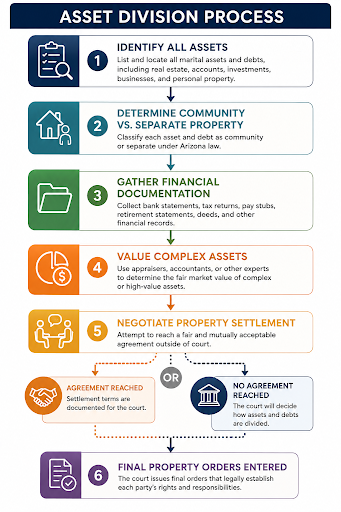
Asset Division Roadmap
Hidden Assets
Not every spouse fully discloses their finances during a divorce. Unfortunately, some people attempt to hide income or assets in an effort to keep a larger share of the marital estate.
Warning signs may include:
- Sudden transfers to family members or friends
- Unexplained withdrawals from bank accounts
- New business expenses that seem excessive
- Missing financial statements
- Large cash purchases
- Cryptocurrency transactions
- Delayed bonuses or commissions
- Unreported investment accounts
If you suspect your spouse is hiding assets, we can help investigate the financial records and determine whether additional discovery or forensic accounting may be necessary.
Transparency is essential to a fair property division.
What Happens When Separate Property Becomes Commingled?
One of the most common asset division disputes involves commingled property.
Separate property can lose its separate character if it becomes so intertwined with community property that it cannot easily be distinguished.
Examples include:
- Depositing inherited money into a joint checking account
- Using marital income to improve a home owned before marriage
- Mixing separate investments with community funds
- Paying a mortgage on separately owned real estate using marital earnings
These situations require careful financial tracing to determine whether all or part of an asset should remain separate.
Because every case is different, we carefully review the history of each disputed asset before recommending a strategy.
Dividing Debt During Divorce
Property is only one side of the financial picture.
Debt must also be divided.
Arizona courts may allocate responsibility for:
- Mortgage balances
- Home equity loans
- Vehicle loans
- Credit card balances
- Medical debt
- Student loans
- Business liabilities
- Tax obligations
Not every debt is automatically divided equally.
The purpose, timing, and nature of the debt may all affect how responsibility is ultimately assigned.
Understanding these obligations before finalizing your divorce helps prevent unpleasant financial surprises later.
Common Debts in Arizona Divorce
Debt Type | Frequently Divided? | Notes |
Mortgage | ✔ | Often tied to real estate division |
Credit Cards | ✔ | Depends on when debt was incurred |
Auto Loans | ✔ | Usually follows vehicle ownership |
Student Loans | Sometimes | May depend on circumstances |
Medical Bills | ✔ | Often considered marital debt |
Business Loans | Sometimes | May require additional valuation |
Business Valuation Can Change Everything
If one or both spouses own a business, determining its value becomes one of the most important parts of the divorce.
Several valuation methods may be used depending on the circumstances, including:
- Income approach
- Asset approach
- Market approach
Business valuation professionals may review:
- Tax returns
- Payroll records
- Profit and loss statements
- Balance sheets
- Contracts
- Accounts receivable
- Business goodwill
An inaccurate valuation can dramatically affect the final settlement.
That is why we work with trusted financial professionals whenever appropriate.
Tax Consequences Matter
Many people focus only on who receives which assets.
Equally important is understanding the tax impact of those assets.
For example:
A retirement account worth $250,000 does not necessarily have the same after-tax value as a brokerage account worth $250,000.
Selling investment property may trigger capital gains taxes.
Business transfers can create additional tax considerations.
Our goal is to help clients evaluate the entire financial picture rather than simply comparing dollar amounts.
A settlement that appears equal today may produce very different financial outcomes tomorrow if taxes are ignored.
Can We Settle Without Going to Court?
Yes.
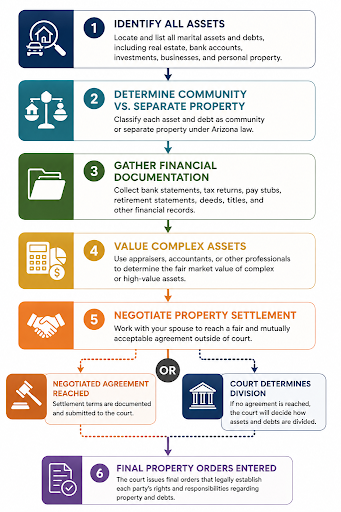
Many property division cases resolve through negotiation or mediation.
Settlement often provides:
- Greater privacy
- Lower legal costs
- More flexibility
- Faster resolution
- Greater control over the outcome
However, settlement should never come at the expense of fairness.
If negotiations fail, we are fully prepared to present your case before the court.
Because we prepare every case thoroughly from the beginning, we are ready whether resolution occurs around the negotiating table or in the courtroom.
Asset Division Timeline
Mistakes to Avoid During Asset Division
Divorce often involves emotional decisions.
Some of the most costly mistakes include:
- Agreeing to a settlement before understanding every asset
- Forgetting about retirement accounts
- Overlooking tax implications
- Assuming debts disappear after divorce
- Hiding assets
- Selling property before consulting an attorney
- Ignoring business valuation
- Relying on verbal agreements
Taking the time to understand your rights today can prevent years of financial regret.
Local Resources for San Tan Valley Residents
Pinal County Superior Court
971 N. Jason Lopez Circle
Florence, AZ 85132
The Pinal County Superior Court handles divorce, property division, and other family law matters for San Tan Valley residents.
Pinal County Assessor
The Assessor’s Office provides property valuation information that may become relevant during real estate division.
Pinal County Recorder
The Recorder maintains records involving deeds and property ownership that may be important when identifying marital assets.
Arizona Judicial Branch
Provides Arizona family law forms and information regarding divorce proceedings.
Why Work With Nye Family Law?
Dividing assets is about more than numbers on a spreadsheet.
It is about protecting the financial future you have worked hard to build.
When you hire Nye Family Law, you gain a legal team committed to:
- Listening to your goals
- Explaining every available option
- Protecting your financial interests
- Preparing every case thoroughly
- Negotiating strategically
- Litigating aggressively when necessary
We understand that every divorce presents unique financial challenges.
Our approach is personalized because no two families have the same priorities.
Whether your case involves a modest marital estate or significant assets accumulated over many years, we work to secure an outcome that positions you for long-term financial stability.
Frequently Asked Questions
Is Arizona a 50/50 divorce state?
Arizona follows community property laws. While community property is generally divided equitably, the division of individual assets is not always an exact fifty-fifty split.
What happens to the family home?
The home may be sold, awarded to one spouse with an offsetting asset distribution, or retained temporarily under certain circumstances.
Is my inheritance protected?
Inheritances generally remain separate property unless they become commingled with community assets.
What if my spouse owned a business before marriage?
A business started before marriage may remain partially separate property, but any increase in value during the marriage could create additional legal issues depending on the circumstances.
Are retirement accounts divided?
Often, yes. The portion accumulated during the marriage is frequently considered community property.
What is a QDRO?
A Qualified Domestic Relations Order allows certain retirement accounts to be divided without triggering unnecessary taxes or penalties.
What if my spouse is hiding money?
The court has procedures available to require financial disclosures. Additional investigation may also be appropriate depending on the facts.
Can debt be divided even if it’s only in my spouse’s name?
Yes. The name on an account does not always determine whether a debt is considered community or separate under Arizona law.
Will I have to go to court?
Not necessarily. Many property division disputes are resolved through negotiation or mediation. If court becomes necessary, we are prepared to advocate for your interests.
How long does asset division take?
The timeline depends on the complexity of the assets, the level of disagreement between spouses, and the court’s schedule. Cases involving businesses or extensive financial portfolios generally take longer.
Can we decide how to divide our property ourselves?
Yes. Spouses may negotiate a property settlement agreement, but it should be reviewed carefully to ensure it is fair, enforceable, and protects your long-term financial interests.
Do I need an attorney for asset division?
While not legally required, experienced legal representation can help identify hidden issues, protect separate property, evaluate complex assets, and negotiate a settlement that reflects your best interests.
Speak With a San Tan Valley Asset Division Lawyer Today
Every financial decision made during a divorce has the potential to affect your future for years to come.
Whether you are concerned about protecting your home, dividing retirement accounts, preserving a business, or ensuring marital property is valued fairly, we are here to help.
At Nye Family Law, we provide strategic guidance, personalized representation, and strong advocacy for clients throughout San Tan Valley and Pinal County.
If you are facing divorce and have questions about property division, let us help you protect what matters most.
Call Nye Family Law today at 480-253-9065 to schedule your consultation.