



Nye Family Law represents clients throughout San Tan Valley, Arizona, in all types of divorce cases, including uncontested, mediated, and contested matters filed in Pinal County Superior Court. Attorney Dexton H. Nye is a former prosecutor who is bilingual in English and Spanish and guides clients through property division, child custody, child support, and spousal maintenance issues under Arizona Revised Statutes Title 25.
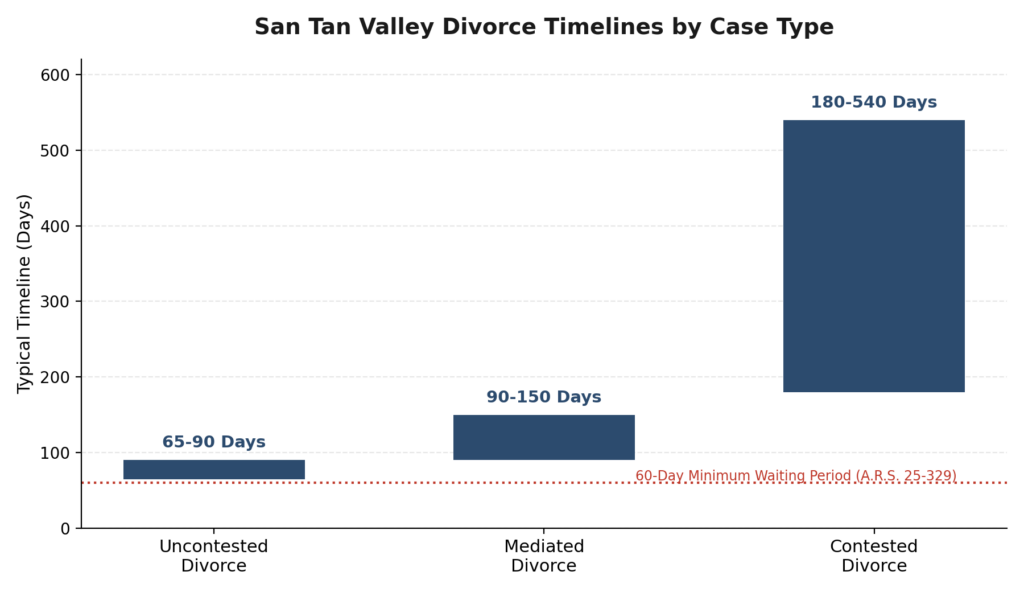
The firm offers direct attorney access, transparent timelines, and representation designed around the specific pace and requirements of the Pinal County court system. Divorce cases in Arizona require a minimum sixty-day waiting period after service under A.R.S. 25-329, with the overall timeline and cost varying significantly based on whether the case is uncontested, mediated, or contested.
Why San Tan Valley Residents Choose Nye Family Law
San Tan Valley has grown rapidly over the past decade, and many residents who file for divorce here are unaware that their case is filed in Pinal County Superior Court rather than Maricopa County, even though the surrounding East Valley communities of Mesa, Chandler, and Gilbert fall under Maricopa County jurisdiction. This distinction affects filing procedures, court scheduling, and local rules that apply to a divorce case.
Attorney Dexton H. Nye brings a former prosecutor’s courtroom experience to every divorce matter, along with the ability to communicate directly with Spanish-speaking clients without relying on a third-party interpreter during sensitive conversations. Our firm limits caseloads so that each client receives direct access to their attorney rather than being routed through a rotating team of paralegals.
We understand that no two divorces look the same. A young couple with no children and few shared assets faces a very different process than a couple with a family business, a military pension, or a contested custody dispute. We build a strategy around the realities of each case rather than applying a one-size-fits-all approach.
Understanding Divorce Law in Arizona
Arizona is a no-fault divorce state. This means that a spouse filing for what Arizona law calls dissolution of marriage does not need to prove wrongdoing such as adultery or abandonment. Under A.R.S. 25-312, the court only needs to find that the marriage is irretrievably broken, or in covenant marriage cases, that specific statutory grounds exist.
To file for divorce in Pinal County, at least one spouse must have been a resident of Arizona for a minimum of ninety days before filing, as required by A.R.S. 25-312. Once a petition is filed, the responding spouse must be formally served, and Arizona law imposes a mandatory sixty-day waiting period from the date of service before a final decree can be entered under A.R.S. 25-329. This waiting period exists even in fully agreed cases, which is why the fastest possible uncontested divorce in San Tan Valley still takes a minimum of two months.
Arizona is also a community property state under A.R.S. 25-211. This means that most assets and debts acquired during the marriage are presumed to belong equally to both spouses, regardless of whose name appears on the title or account. Property owned before the marriage, along with gifts and inheritances received individually during the marriage, generally remains separate property under A.R.S. 25-213, though commingling can complicate this classification.
Types of Divorce Cases We Handle in San Tan Valley
Uncontested Divorce
An uncontested divorce occurs when both spouses agree on every major issue, including property division, custody, support, and any other outstanding matter. Because there is nothing left for a judge to decide, uncontested cases move through Pinal County Superior Court far faster than contested matters and typically involve lower legal costs. We still recommend independent legal review of any settlement agreement, since a signed agreement is difficult to unwind later even if it turns out to be unfavorable.
Mediated Divorce
Mediation is often the right fit for couples who disagree on some issues but are willing to negotiate rather than litigate. A neutral mediator helps both spouses work through disputed topics such as parenting time or asset division outside of a courtroom setting. Mediated agreements are then submitted to the court for approval. Mediation tends to preserve a more cooperative relationship between former spouses, which matters most when children are involved.
Contested Divorce
A contested divorce arises when spouses cannot agree on one or more major issues and the court must resolve the dispute. Contested cases involve formal discovery, financial disclosure, and often a trial before a Pinal County Superior Court judge. These cases take longer and cost more, but they are sometimes unavoidable, particularly when there are concerns about hidden assets, a parent’s fitness to care for a child, or a significant disagreement over the value of a business or property.
Comparing Your Divorce Options
| Factor | Uncontested | Mediated | Contested |
|---|---|---|---|
| Typical Timeline | 65 to 90 days | 90 to 150 days | 180 to 540 days |
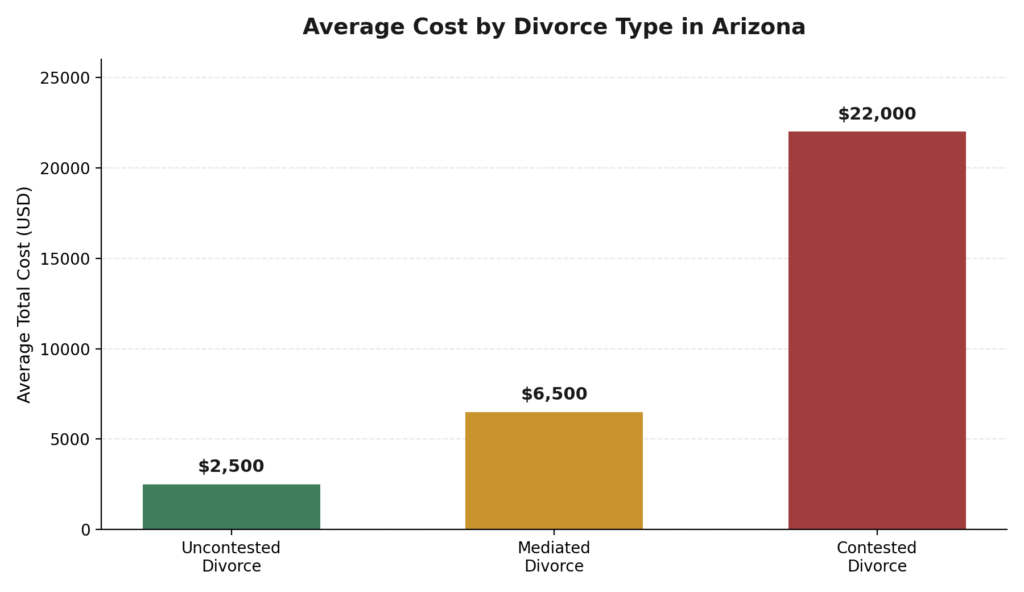
| Average Cost | $1,500 to $3,500 | $4,000 to $9,000 | $12,000 to $35,000 or more |
| Court Appearances | Usually none or one | Usually one | Multiple, including possible trial |
| Best Suited For | Full agreement on all issues | Willingness to negotiate | Significant disputes or safety concerns |
Divorce Timelines by Case Type
Average Cost by Divorce Type
The Divorce Process in Pinal County Superior Court
While every case is different, most San Tan Valley divorces move through the same general sequence in Pinal County Superior Court.
- Filing the Petition. One spouse, called the petitioner, files a Petition for Dissolution of Marriage along with a Preliminary Injunction and, if applicable, a Sensitive Data Sheet.
- Service of Process. The other spouse, called the respondent, must be formally served with the petition and supporting documents.
- Response Period. The respondent has twenty days to file a response if served in Arizona, or thirty days if served outside the state.
- Financial Disclosure. Both spouses exchange financial affidavits and supporting documentation under Rule 49 of the Arizona Rules of Family Law Procedure.
- Negotiation or Mediation. Many cases resolve at this stage through direct negotiation or court ordered mediation.
- Temporary Orders. If needed, either spouse can request temporary orders addressing parenting time, support, or use of property while the case is pending.
- Trial, if Necessary. Unresolved issues are decided by a judge at trial.
- Final Decree. Once all issues are resolved and the sixty day waiting period has passed, the court enters a final Decree of Dissolution of Marriage.
Property and Debt Division
Dividing community property is often the most contested part of a San Tan Valley divorce, particularly for couples with a home, retirement accounts, a family business, or significant debt. Arizona courts aim for an equitable division of community property under A.R.S. 25-318, which usually means a roughly equal split, though the court retains discretion to divide assets unequally in certain circumstances, such as when one spouse has engaged in excessive or fraudulent spending of community funds.
We regularly help clients identify separate property that should be excluded from division, trace commingled funds, and value complex assets such as small businesses or pensions. For a deeper look at how Arizona courts approach this issue, see our dedicated San Tan Valley Asset Division Attorney page.
Child Custody and Parenting Time
Arizona law refers to what many people call custody as legal decision-making authority and parenting time under A.R.S. 25-403. Courts decide these matters based on the best interests of the child, considering factors such as each parent’s relationship with the child, the child’s adjustment to home and school, and any history of domestic violence or substance abuse.
Parents who reach their own parenting plan can submit it for court approval, while disputed cases may require a judge to decide. Our San Tan Valley Child Custody Attorney page covers this process in greater depth.
Child Support
Child support in Arizona is calculated using the Arizona Child Support Guidelines, which weigh both parents’ incomes, the parenting time schedule, and costs such as health insurance and childcare. Support obligations can later be modified if there is a substantial and continuing change in circumstances. Learn more on our San Tan Valley Child Support Attorney page.
Spousal Maintenance
Not every divorce involves spousal maintenance, often called alimony in other states. Arizona courts consider factors under A.R.S. 25-319, including the length of the marriage, each spouse’s earning ability, and whether one spouse sacrificed career opportunities to support the household or raise children. Maintenance may be awarded for a limited period or, in longer marriages, for an extended duration. Visit our San Tan Valley Spousal Support Attorney page for a full breakdown.
Filing Fees and Practical Costs in Pinal County
Beyond attorney fees, every divorce filed in Pinal County Superior Court involves a filing fee paid to the clerk of the court, along with a response fee if the other spouse contests the petition. Additional costs can include service of process fees if a professional process server is used, fees for a parenting class required in cases involving minor children, and costs tied to expert witnesses such as appraisers or forensic accountants in more complex contested cases. Clients who qualify based on income may be eligible for a fee waiver, which we can help evaluate during an initial consultation.
We are transparent about costs from the first conversation, because we know that uncertainty about legal fees is one of the biggest sources of stress for people considering divorce. We structure our fee arrangements around the type of case involved, whether that is a flat fee for a straightforward uncontested matter or an hourly arrangement for a more contested dispute.
Domestic Violence and Safety Concerns
Some San Tan Valley residents delay filing for divorce because they are afraid of a spouse’s reaction. Arizona law allows a spouse to request an Order of Protection separately from the divorce case if there is a genuine safety concern, and a Preliminary Injunction automatically issues alongside every divorce petition to prevent either spouse from harassing, disturbing the peace of, or removing children from the state without consent.
Courts are also required to consider evidence of domestic violence when making decisions about legal decision-making authority and parenting time under A.R.S. 25-403. If safety is a concern in your situation, tell your attorney immediately so appropriate protective steps can be built into your case from the outset.
Same Sex Divorce in Arizona
Arizona recognizes same sex marriage and applies the same dissolution laws to same sex couples as it does to opposite sex couples. Community property rules, child custody standards, and spousal maintenance factors apply equally regardless of the spouses’ genders. Couples who married in another state before relocating to San Tan Valley can still file for divorce in Pinal County as long as Arizona residency requirements are satisfied.
Common Mistakes to Avoid During a San Tan Valley Divorce
We regularly see the same avoidable mistakes cause unnecessary delay or expense in divorce cases. Being aware of these issues early can save significant time and money.
- Hiding assets. Courts take a dim view of spouses who conceal accounts, property, or income, and doing so can result in an unequal division of property as a penalty.
- Signing an agreement without review. A settlement agreement is a binding contract once approved by the court, so it should always be reviewed by an attorney before signing, even if the process feels amicable.
- Ignoring temporary orders. Violating a temporary order regarding parenting time, support, or use of property can create serious credibility problems later in the case.
- Making major financial decisions during the case. Large purchases, new debt, or moving significant funds can complicate property division and raise questions about intent.
- Involving children in the conflict. Speaking negatively about the other parent in front of children, or using children to relay messages, can affect custody outcomes and harm a child’s well-being.
How to Prepare for Your Initial Consultation
Coming to your first meeting prepared helps us give you a clearer picture of your options from the start. We generally ask clients to gather the following before the consultation.
- A general list of marital assets and debts, including real estate, vehicles, retirement accounts, and credit cards.
- Recent income documentation for both spouses, such as pay stubs or tax returns.
- Any existing prenuptial or postnuptial agreement.
- A basic outline of your current parenting arrangement, if you have children.
- Any documentation related to safety concerns, if applicable.
You do not need to have every document in hand before calling. We can walk you through what is needed and help you gather the rest as your case moves forward.
Protecting Your Interests Before You File
Some couples enter a marriage or later formalize an agreement about how assets and debts would be handled in the event of a divorce. A valid prenuptial agreement can simplify a future divorce considerably by resolving property division questions in advance. If you already have a prenuptial agreement, our San Tan Valley Prenuptial Agreement Attorney page explains how these agreements are enforced in Arizona.
Military Divorce Considerations
San Tan Valley is within reach of several military families connected to Luke Air Force Base and other installations. Military divorces involve additional layers, including the Survivor Benefit Plan, division of military retirement pay under federal law, and jurisdictional questions tied to a service member’s home of record. Our San Tan Valley Military Divorce Attorney page addresses these issues directly.
Frequently Asked Questions
How long does a divorce take in San Tan Valley, Arizona?
An uncontested divorce can be finalized in as little as sixty five to ninety days, since Arizona law requires a minimum sixty day waiting period after service under A.R.S. 25-329. Contested divorces can take six months to over a year depending on the complexity of the issues and the Pinal County Superior Court calendar.
Is Arizona a fifty fifty state for divorce?
Arizona is a community property state, which generally means marital assets and debts are divided equally, though the court has discretion to divide property unequally in certain situations under A.R.S. 25-318.
Do I have to go to court for my San Tan Valley divorce?
Not necessarily. Many uncontested and mediated divorces are finalized without a contested court hearing, though a judge must still review and approve the final decree.
Which court handles divorces filed in San Tan Valley?
San Tan Valley divorces are filed in Pinal County Superior Court, which is a separate court system from Maricopa County Superior Court that handles cases in Mesa, Chandler, and Gilbert.
Can I get divorced in Arizona if my spouse does not agree?
Yes. Arizona is a no-fault state, so the court does not require both spouses to agree in order for a divorce to proceed. A contested divorce simply takes longer because a judge decides the disputed issues.
What does an uncontested divorce cost in San Tan Valley?
Costs vary by case, but a straightforward uncontested divorce with a written agreement often ranges from about $1,500 to $3,500 in attorney fees, in addition to court filing fees.
Can a prenuptial agreement affect my divorce?
Yes. A valid, properly executed prenuptial agreement can determine how property and debt are divided, which can significantly reduce disputes during the divorce process.
Speak With a San Tan Valley Divorce Attorney
If you are considering divorce or have already been served with divorce papers, Nye Family Law is ready to help you understand your options under Arizona law. Call our office at 480-253-9065 to schedule a consultation with Attorney Dexton H. Nye.