


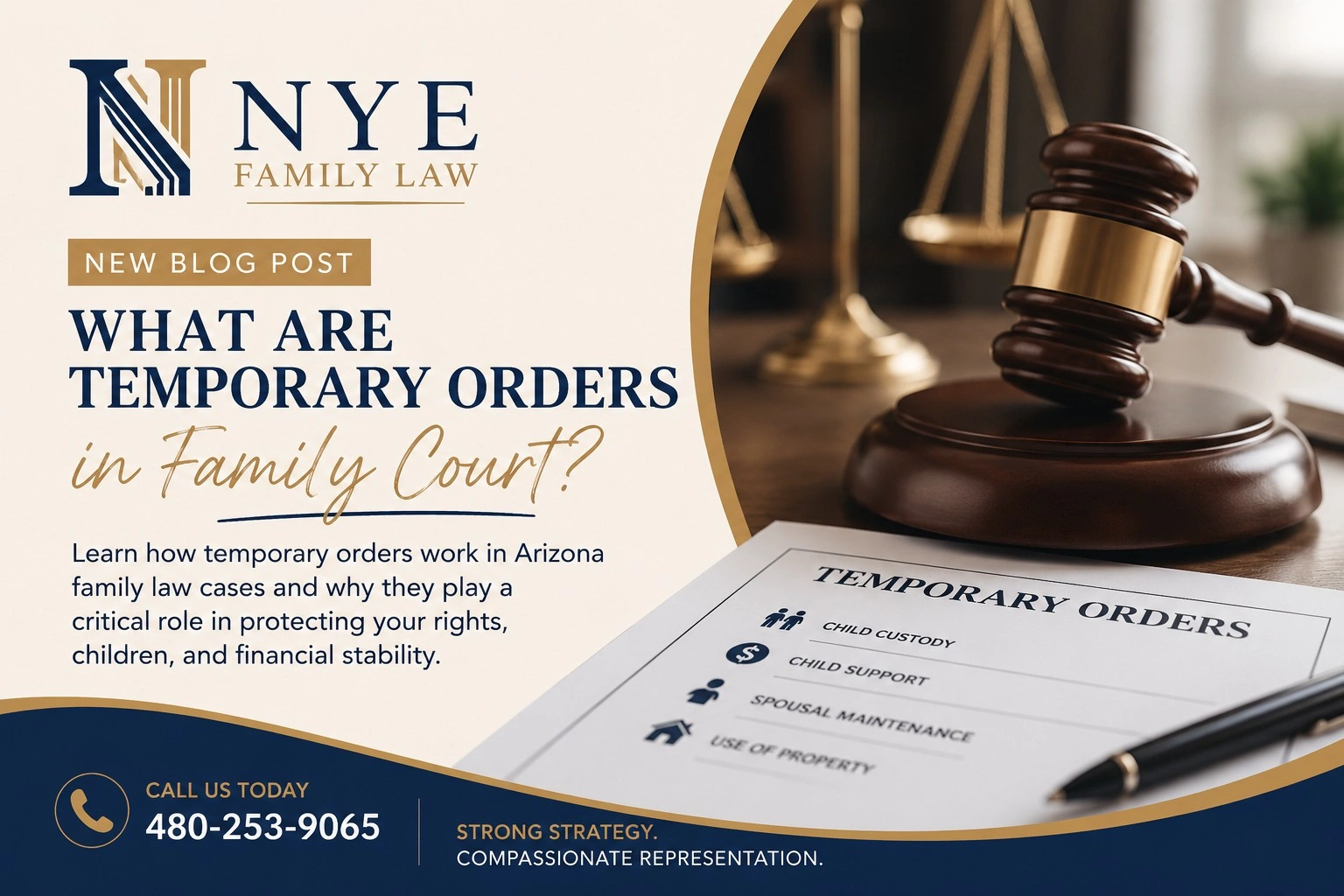
Temporary orders in family court are legally binding decisions made while a divorce, custody, or family law case is still ongoing. These orders help establish short-term rules regarding child custody, parenting time, child support, spousal maintenance, use of property, and financial responsibilities until a final court order is entered. In Arizona, temporary orders are often critical because they provide structure, maintain stability, and can influence the direction of the case.
At Nye Family Law, PLLC, clients receive strategic guidance through temporary order hearings and negotiations from experienced family law attorneys, helping them protect their rights, finances, and relationship with their children during uncertain times.
Trusted Family Law Representation in Arizona
- Former prosecutor with courtroom litigation experience
- Family law-focused legal practice serving Arizona families
- Customized legal strategies based on each family’s circumstances
- Compassionate and responsive client support throughout the legal process
- Strong client testimonials emphasizing professionalism and care
Understanding Temporary Orders in Arizona Family Court
Family law cases rarely resolve overnight. Divorce, child custody disputes, and support matters can take months, and sometimes longer, to fully conclude. During that time, families still need structure, financial stability, and clear expectations.
That is where temporary orders come into play.
Temporary orders are court-issued instructions that remain in effect while a family law case is pending. These orders are designed to address urgent or ongoing issues so that neither party is left in legal limbo while waiting for a final judgment.
In many cases, temporary orders are among the most important stages of a case because they establish routines and expectations early in the process.
Why Temporary Orders Matter So Much
Many people assume temporary orders are only short-term technicalities. In reality, they can significantly impact the outcome of a case.
Judges often look at how temporary arrangements are functioning when making long-term decisions. For example, if a temporary parenting schedule has worked well for several months, the court may be more inclined to continue that arrangement permanently.
Temporary orders can affect:
- Child custody schedules
- Financial responsibilities
- Living arrangements
- Access to marital property
- Day-to-day parenting routines
Because these orders can shape the direction of the case, it is critical to approach them strategically rather than casually.
Common Types of Temporary Orders in Family Court
Temporary Child Custody Orders
One of the most common reasons for temporary orders involves children.
Arizona courts prioritize the best interests of the child, and temporary custody orders help create stability while the case is ongoing. These orders can establish:
- Parenting schedules
- Exchange locations
- Decision-making authority
- Holiday and vacation arrangements
Without temporary custody orders, disagreements between parents can quickly escalate into conflict and confusion.
Temporary Child Support Orders
Children still require financial support while the case is pending. Temporary child support orders ensure that financial responsibilities are addressed immediately instead of waiting for a final judgment.
Arizona courts generally use state guidelines when calculating support amounts, but additional factors may also be considered depending on the circumstances.
Temporary Spousal Maintenance
In some cases, one spouse may need temporary financial assistance during the divorce process. Temporary spousal maintenance can help address immediate living expenses while the case proceeds.
This is especially common when:
- One spouse earns significantly more income
- One spouse has been financially dependent
- There are large differences in earning capacity
Temporary Use of Property
Divorce often creates practical questions about who remains in the family home, who uses certain vehicles, or who has access to specific accounts.
Temporary property orders can determine:
- Who stays in the marital residence
- Responsibility for mortgage or rent payments
- Temporary use of vehicles
- Payment of household expenses
These issues can become highly contentious without clear court direction.
Temporary Protective Orders
In situations involving allegations of domestic violence, harassment, or threats, the court may issue temporary protective orders to ensure safety while the case proceeds.
These orders can restrict contact or establish emergency parenting limitations depending on the situation.
How Temporary Orders Are Requested in Arizona
Filing a Motion for Temporary Orders
A party seeking temporary relief typically files a formal request with the court. This request outlines:
- What orders are being requested
- Why are they necessary
- Supporting facts and evidence
The other party usually has an opportunity to respond before a hearing is scheduled.
Temporary Orders Hearings
The court may hold a hearing on temporary orders, during which both parties present arguments and evidence.
Evidence may include:
- Financial records
- Parenting schedules
- Text messages or emails
- Witness testimony
- Employment documentation
Because these hearings can directly affect the case’s trajectory, preparation is extremely important.
What Judges Consider During Temporary Orders Hearings
Child-Related Factors
When children are involved, Arizona judges focus heavily on stability and the child’s best interests.
The court may evaluate:
- Each parent’s involvement in the child’s life
- Communication between parents
- School and routine stability
- Health and safety concerns
Financial Considerations
Judges also assess each party’s financial situation when making temporary support decisions.
This can include:
- Income and employment status
- Existing expenses
- Debts and obligations
- Access to marital assets
Accuracy and organization matter. Incomplete or misleading financial disclosures can damage credibility in court.
The Strategic Importance of Temporary Orders
Temporary orders are not just administrative steps—they are strategic moments within a family law case.
For example:
- A temporary parenting arrangement may influence permanent custody decisions
- Temporary support obligations can affect financial negotiations later
- Early courtroom impressions can shape how the judge views the case overall
This is one reason experienced legal representation is so important. The way temporary issues are handled can affect the overall direction of the case.
How Nye Family Law Approaches Temporary Orders Cases
Preparation and Courtroom Readiness
Attorney Dexton H. Nye brings courtroom experience developed through his work as a former prosecutor.
That background provides valuable insight into:
- Presenting persuasive evidence
- Anticipating opposing arguments
- Structuring effective legal strategies
At Nye Family Law, PLLC, temporary orders are approached with the same level of preparation as major court proceedings because the stakes are often high.
Personalized Legal Strategies
Every family’s situation is different. The firm develops customized legal approaches based on each client’s priorities, concerns, and long-term goals.
This may involve:
- Protecting parenting rights
- Preserving financial stability
- Minimizing unnecessary conflict
- Positioning the client for favorable long-term outcomes
Client Communication and Support
Family law proceedings can feel overwhelming, especially during emotionally charged situations.
Clients benefit from:
- Clear explanations of the process
- Honest guidance about expectations
- Consistent communication throughout the case
This level of support helps clients feel informed and prepared during uncertain times.
Common Mistakes People Make With Temporary Orders
Assuming Temporary Means Unimportant
One of the biggest mistakes people make is treating temporary orders casually. Courts often view temporary arrangements as indicators of what may work long term.
Failing to Follow Court Orders
Violating temporary orders can seriously damage your credibility and potentially affect final rulings.
Even if you disagree with an order, compliance is critical unless the court formally modifies the order.
Going Into Hearings Unprepared
Temporary orders hearings move quickly. Arriving without documentation, evidence, or a clear strategy can significantly weaken your position.
Temporary Orders and Long-Term Outcomes
Although temporary orders are technically short-term, their practical impact often extends far beyond the duration of the case.
Temporary arrangements can:
- Establish parenting patterns
- Influence settlement negotiations
- Shape judicial perceptions
- Create financial expectations
Because of this, temporary orders should always be approached with a long-term strategy in mind.
How Long Do Temporary Orders Last?
Temporary orders generally remain in effect until:
- The final divorce decree is entered
- A final custody order is issued
- The court modifies the temporary order
In some cases, parties may agree to revised temporary arrangements during the case.
Can Temporary Orders Be Changed?
Yes. Temporary orders can sometimes be modified if circumstances change significantly or if there is a compelling reason for adjustment.
Examples may include:
- Changes in employment or income
- Relocation issues
- Safety concerns involving children
- Violations of existing orders
However, modifications require court approval and supporting evidence.
Why Legal Representation Matters During Temporary Orders Hearings
Temporary orders hearings often occur early in a case, when emotions are high, and uncertainty is overwhelming. Having an experienced family law attorney can make a substantial difference in both preparation and presentation.
An attorney helps:
- Organize evidence effectively
- Present strong legal arguments
- Protect your rights during negotiations
- Avoid procedural mistakes
At Nye Family Law, PLLC, clients receive focused legal guidance designed to protect both their immediate needs and long-term interests.
Moving Forward With Confidence
Temporary orders are one of the most important parts of many family law cases. They provide stability during uncertainty and often shape what happens later in court.
Whether you are dealing with divorce, custody issues, or financial disputes, having strategic legal guidance during this stage can significantly impact your future.
Nye Family Law, PLLC, helps clients throughout Arizona navigate temporary orders proceedings with preparation, clarity, and strong advocacy.
Frequently Asked Questions
What are temporary orders in family court?
Temporary orders are short-term court rulings that establish rules and responsibilities while a family law case is ongoing.
What issues can temporary orders address?
Temporary orders may cover custody, parenting time, child support, spousal support, property use, and financial obligations.
Are temporary orders legally enforceable?
Yes. Temporary orders are legally binding and must be followed unless modified by the court.
Can temporary orders affect the outcome of a case?
Yes. Courts often consider how temporary arrangements are functioning when making final decisions.
How quickly can temporary orders be issued?
The timeline varies depending on the court and the urgency of the situation. Emergency orders may be issued more quickly in certain cases.
Can temporary orders be modified?
Yes, but modifications generally require proof of changed circumstances or another valid legal basis.
Do I need an attorney for temporary orders hearings?
While not legally required, having an attorney can significantly improve your ability to present evidence, protect your rights, and avoid mistakes.If you need guidance regarding temporary orders in a divorce or custody case, Nye Family Law, PLLC is prepared to help you protect your rights and move forward with confidence.