



Spousal support, also known as spousal maintenance or alimony, is financial support that one spouse may be ordered to pay the other during or after a divorce. Unlike child support, there is no automatic formula that determines eligibility or the amount. Arizona courts evaluate numerous statutory factors, including the length of the marriage, each spouse’s financial resources, earning capacity, standard of living during the marriage, age, health, and contributions made throughout the relationship.
At Nye Family Law, we represent clients throughout San Tan Valley who are seeking, contesting, modifying, or enforcing spousal maintenance orders. Whether your divorce involves a long-term marriage, a significant income disparity, or complex financial circumstances, we develop strategies designed to protect your long-term financial future.
We help clients with:
- Temporary spousal maintenance
- Post-divorce spousal support
- High-income divorce cases
- Long-term marriages
- Spousal support modifications
- Enforcement of unpaid maintenance
- Negotiated settlement agreements
- Litigation involving contested support
Our goal is to help you pursue a fair financial outcome while protecting your future after divorce.
Helping You Move Forward Financially After Divorce
Divorce changes nearly every aspect of your financial life.
For many spouses, one of the biggest concerns is whether they will be able to maintain financial stability after the marriage ends. One spouse may have spent years raising children, managing the household, supporting the other spouse’s career, or stepping away from the workforce altogether.
Arizona law recognizes that these circumstances sometimes justify financial support.
At Nye Family Law, we help clients throughout San Tan Valley understand whether spousal maintenance may apply to their situation and advocate for fair outcomes based on the facts of each case.
Every family has a different financial story. Our job is to help ensure yours is presented clearly and effectively.
Why Clients Choose Nye Family Law
Spousal maintenance cases often involve far more than comparing two incomes.
They require careful analysis of financial records, employment history, future earning capacity, marital lifestyle, and the unique circumstances that shaped the marriage.
When you hire our firm, you receive:
- Personalized legal guidance
- Thorough financial analysis
- Strategic negotiation
- Courtroom advocacy when needed
- Honest communication
- A legal team focused exclusively on Arizona family law
We understand that financial uncertainty creates stress. Our goal is to provide clarity while protecting your long-term interests.
What Is Spousal Maintenance?
Spousal maintenance, sometimes called alimony or spousal support, is court-ordered financial assistance paid from one spouse to the other during or after divorce.
Unlike child support, there is no guaranteed right to receive spousal maintenance.
Instead, Arizona courts first determine whether a spouse qualifies under state law before deciding the amount and duration of any award.
Not every divorce includes spousal support.
When it does, every case is highly fact-specific.
Who May Qualify for Spousal Support?
Arizona law identifies several situations where a spouse may qualify for maintenance.
A spouse may be eligible if they:
- Lack sufficient property to meet reasonable needs
- Are unable to become self-sufficient through employment
- Contributed significantly to the education or career of the other spouse
- Had a long marriage and are approaching retirement age
- Reduced career opportunities for the benefit of the marriage or family
Meeting one of these eligibility factors does not automatically determine how much support will be awarded.
Instead, eligibility simply allows the court to move to the next stage of the analysis.
Spousal Maintenance Eligibility Checklist
Possible Qualification | May Support Eligibility? |
Long-term marriage | ✔ |
Significant income disparity | ✔ |
Stay-at-home parent | ✔ |
Disability or chronic illness | ✔ |
Limited earning capacity | ✔ |
Supported spouse’s education | ✔ |
Short marriage with similar incomes | Less likely |
Both spouses financially independent | Less likely |
Temporary vs. Long-Term Spousal Maintenance
Not all maintenance orders serve the same purpose.
Some are designed to provide immediate financial stability during the divorce process.
Others continue after the divorce becomes final.
Temporary Spousal Maintenance
Temporary support may help one spouse pay living expenses while the divorce is pending.
It can provide stability until the court enters a final divorce decree.
Post-Divorce Maintenance
Some maintenance awards continue after the divorce is finalized.
These payments may be:
- Short-term
- Rehabilitative
- Long-term
- Indefinite in limited circumstances
The duration depends on the facts of the case rather than a fixed schedule.
Temporary vs. Long-Term Maintenance
Temporary Support | Long-Term Support |
During divorce | After divorce |
Ends when divorce concludes | Continues under court order |
Helps maintain financial stability | Helps transition toward independence |
Often based on immediate need | Based on statutory factors |
How Arizona Courts Decide Spousal Maintenance
Unlike child support, Arizona does not use a mathematical formula to determine maintenance.
Instead, judges evaluate numerous statutory considerations before deciding whether support is appropriate.
Some of the most important factors include:
- Length of the marriage
- Standard of living during the marriage
- Age of each spouse
- Physical health
- Emotional health
- Income
- Employment history
- Education
- Future earning capacity
- Financial resources
- Contributions to the marriage
- Time needed for education or job training
Each case is unique.
The court examines the complete financial picture rather than relying on one single factor.
Factors Courts Frequently Consider
Factor | Why It Matters |
Length of marriage | Longer marriages often receive greater consideration |
Income difference | Significant disparities may support maintenance |
Employment history | Time outside the workforce may affect earning ability |
Education | May impact future income potential |
Age | Older spouses may face greater employment challenges |
Health | Medical conditions may affect earning capacity |
Standard of living | Courts attempt to consider the marital lifestyle |
Financial resources | Existing assets may affect support needs |
Does Every Long Marriage Result in Spousal Support?
No.
Length of marriage is important, but it is only one factor.
Some spouses have substantial retirement savings, separate assets, or similar incomes despite decades of marriage.
Others may require support after much shorter marriages because of disability, caregiving responsibilities, or significant financial dependence.
Rather than relying on assumptions, we carefully evaluate every financial detail before advising clients about likely outcomes.
Can Stay-at-Home Parents Receive Spousal Maintenance?
Many can.
One spouse may have spent years managing the household, raising children, or supporting the other spouse’s career instead of pursuing outside employment.
Those contributions often create financial consequences after divorce.
Returning to the workforce may require:
- Additional education
- Job training
- Professional licensing
- Time to rebuild work experience
Arizona courts may consider these realities when evaluating maintenance requests.
Rehabilitative Spousal Support
Many maintenance awards are intended to help a spouse become financially independent.
This type of support often provides financial assistance while the receiving spouse:
- Completes education
- Obtains professional certifications
- Re-enters the workforce
- Builds employment experience
- Increases earning capacity
The ultimate goal is often long-term self-sufficiency rather than permanent dependence.
High-Income Divorce Cases
Spousal maintenance can become particularly complex when one or both spouses have substantial income or assets.
High-income divorces often involve:
- Executive compensation
- Bonuses
- Stock options
- Business ownership
- Investment income
- Deferred compensation
- Multiple real estate holdings
Evaluating these financial resources requires detailed preparation and careful documentation.
We work to present a complete financial picture that reflects the realities of each client’s circumstances.
How a Spousal Maintenance Case Typically Progresses
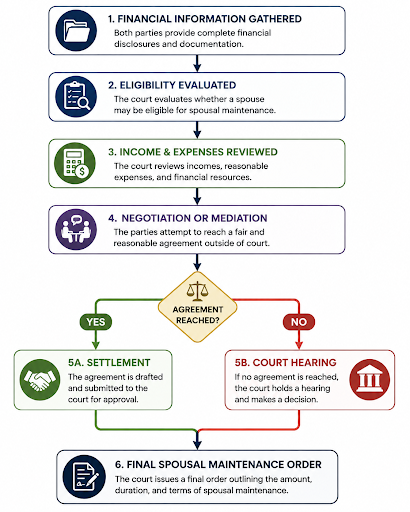
How Arizona Courts Determine the Amount of Spousal Support
After deciding that a spouse qualifies for maintenance, the court must determine how much support should be awarded and how long it should last.
Unlike child support, Arizona does not provide judges with a mandatory calculation or formula.
Instead, courts examine the financial circumstances of both spouses and weigh multiple factors before reaching a decision.
Among the issues a court may evaluate are:
- Each spouse’s monthly income
- Monthly living expenses
- Assets received during the divorce
- Future earning potential
- Employment opportunities
- Age and health
- The standard of living established during the marriage
- Contributions one spouse made to the other’s career or education
Every case is different. The amount awarded in one divorce may be entirely different from another marriage with similar incomes because the surrounding circumstances are unique.
How Long Does Spousal Maintenance Last?
The duration of maintenance depends on the facts of the case.
Some awards last only a few months while a spouse completes job training or secures employment.
Others continue for several years.
In longer marriages involving retirement-age spouses or permanent disabilities, maintenance may continue indefinitely unless modified by the court.
Common Types of Maintenance
Type | Typical Purpose |
Temporary | Provides financial stability during divorce |
Rehabilitative | Allows time for education or employment |
Short-Term | Assists with financial transition |
Long-Term | Often associated with lengthy marriages |
Indefinite | Reserved for limited circumstances where self-sufficiency is unlikely |
The court’s primary goal is to reach a fair outcome based on each family’s circumstances rather than applying a one-size-fits-all solution.
Can Spousal Support Be Modified?
Yes.
- Life changes.
- Income changes.
- Employment changes.
- Health changes.
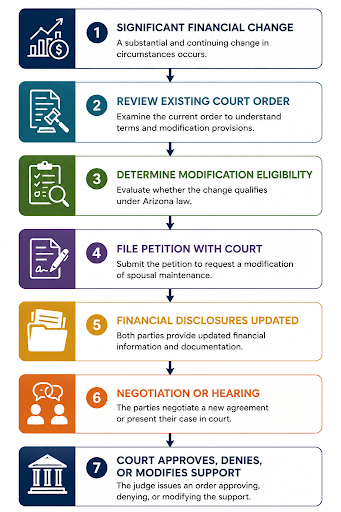
Arizona law allows certain maintenance orders to be modified when there has been a substantial and continuing change in circumstances.
Examples include:
- Loss of employment
- Serious illness
- Disability
- Significant increase in income
- Retirement
- Major change in financial need
However, not every order can be modified.
Some settlement agreements specifically state that maintenance is non-modifiable.
Before requesting a modification, we carefully review the existing order to determine your legal options.
When Does Spousal Support End?
Spousal maintenance does not necessarily continue forever.
Depending on the terms of the order, support may end when:
- The ordered duration expires
- Either spouse passes away
- The receiving spouse remarries
- The court modifies or terminates the order
- A non-modifiable agreement reaches its end date
Every order is unique.
Understanding when maintenance ends can help both parties plan financially for the future.
Spousal Support Modification Timeline
Self-Employed Spouses
Self-employment often creates additional challenges when determining maintenance.
Unlike traditional employees, business owners may receive income through:
- Salary
- Owner draws
- Business distributions
- Bonuses
- Investment income
- Business expenses
Determining actual income requires careful financial review.
We examine tax returns, business records, profit and loss statements, and other documentation to ensure the court receives an accurate picture of each spouse’s financial circumstances.
Retirement and Spousal Maintenance
Retirement frequently raises questions about ongoing maintenance obligations.
If a paying spouse retires, their income may change substantially.
Likewise, the receiving spouse’s retirement income may affect financial need.
Whether maintenance should be modified depends on:
- The existing court order
- The reason for retirement
- Financial resources available to both parties
- Arizona law regarding modification
Every retirement situation should be evaluated individually before assuming maintenance will automatically change.
What Happens if a Spouse Stops Paying?
A court order requiring maintenance is legally enforceable.
If payments stop without court approval, the receiving spouse may have legal remedies available.
Depending on the circumstances, enforcement may include:
- Income withholding
- Contempt proceedings
- Collection of unpaid support
- Entry of judgments
- Attorney’s fees in appropriate cases
Ignoring a court order can create significant legal and financial consequences.
We help clients pursue enforcement while protecting their rights throughout the process.
Tax Considerations
Taxes remain an important part of any financial settlement.
While federal tax laws changed the treatment of many spousal maintenance payments beginning in 2019, tax implications may still arise depending on the circumstances of your divorce and related financial agreements.
We encourage clients to consider both the immediate and long-term financial consequences of any proposed settlement before signing an agreement.
Mistakes to Avoid in Spousal Support Cases
One of the biggest mistakes people make is assuming maintenance is automatic.
Others agree to support terms before fully understanding their long-term financial impact.
Common mistakes include:
- Hiding income
- Failing to disclose assets
- Quitting a job before court
- Ignoring court deadlines
- Agreeing to unreasonable support amounts
- Assuming verbal agreements change court orders
- Waiting too long to request a modification
Proper preparation often leads to better outcomes.
Local Resources for San Tan Valley Residents
Pinal County Superior Court
971 N. Jason Lopez Circle
Florence, AZ 85132
Pinal County Superior Court handles divorce, spousal maintenance, and other family law matters for San Tan Valley residents.
Pinal County Family Court Services
Family Court Services provides resources for mediation, parenting education, and family court information.
Arizona Judicial Branch
The Arizona Judicial Branch offers family law forms, procedural information, and court resources.
Arizona State Bar
Provides public legal resources and attorney information.
Why Work With Nye Family Law?
Spousal maintenance can shape your financial future for years after your divorce.
Whether you are requesting support, contesting a claim, negotiating a settlement, or seeking a modification, you deserve experienced legal guidance focused on your long-term goals.
At Nye Family Law, we take the time to understand your financial situation before developing a strategy tailored to your needs.
We are committed to:
- Honest legal advice
- Personalized representation
- Strong negotiation
- Thorough financial preparation
- Skilled courtroom advocacy when necessary
Our goal is to help you move forward with confidence and financial stability.
Frequently Asked Questions
Is spousal support guaranteed in Arizona?
No. The court must first determine whether a spouse qualifies before considering the amount or duration of support.
Does every divorce involve spousal maintenance?
No. Many divorces conclude without any maintenance award.
Can a stay-at-home parent receive maintenance?
Yes. Arizona courts often consider whether a spouse left the workforce to care for children or support the family.
Can maintenance be modified?
Some maintenance orders can be modified after a substantial and continuing change in circumstances. Others may be non-modifiable if the parties agreed to those terms.
What happens if I lose my job?
Job loss may justify requesting a modification, but the existing order remains enforceable until the court changes it.
Will remarriage end maintenance?
Often, yes. Many maintenance orders terminate upon the receiving spouse’s remarriage, although the specific order should always be reviewed.
Does retirement automatically end support?
No. Retirement may justify a review, but it does not automatically terminate maintenance.
Can maintenance be negotiated instead of litigated?
Yes. Many couples successfully negotiate maintenance agreements during settlement discussions or mediation.
How is maintenance different from child support?
Spousal maintenance provides financial support for a former spouse. Child support is intended to meet the needs of the children and follows different legal standards.
What if my spouse is self-employed?
Self-employment often requires additional financial analysis to determine actual income available for support.
Can the court enforce unpaid maintenance?
Yes. Courts have several enforcement tools available when a spouse fails to comply with a maintenance order.
Do I need a lawyer for a spousal support case?
While not legally required, experienced representation can help protect your financial interests, present accurate financial information, negotiate effectively, and advocate for you in court.
Speak With a San Tan Valley Spousal Support Attorney Today
Spousal maintenance can have a lasting impact on your financial security after divorce. Whether you are seeking support, responding to a request, or asking the court to modify an existing order, having experienced legal guidance can make a meaningful difference.
At Nye Family Law, we help clients throughout San Tan Valley navigate Arizona spousal maintenance cases with preparation, strategy, and personalized attention.
If you have questions about your rights or responsibilities, we are here to help.
Call Nye Family Law today at 480-253-9065 to schedule your consultation and learn how we can help protect your financial future.